Blog
How AI in advertising photography has transformed visual marketing
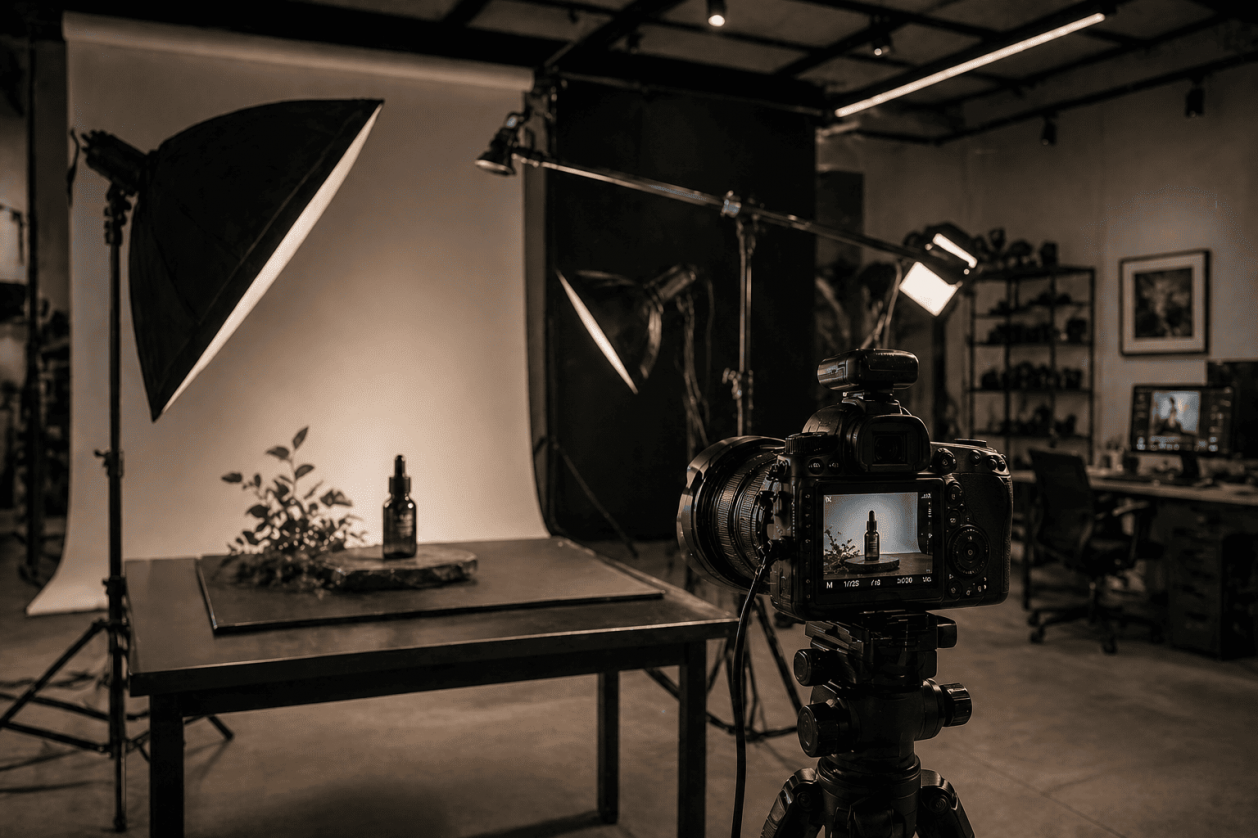
Advertising photography is one of the most important tools in marketing. It sells emotions, builds a brand’s image and, of course, determines whether a customer will notice a product. AI not only supports photographers — it is increasingly taking over part of the creative process, shortening the production time of campaigns from weeks to hours.
What is AI in advertising photography?
AI in advertising photography means using artificial intelligence to create and edit visual materials used in advertising.
In practice, this means:
- generating images without a photoshoot
- creating complete advertising campaigns
- automatically adapting the style to the brand
- quickly testing different advertising variants
Artificial intelligence in advertising photography
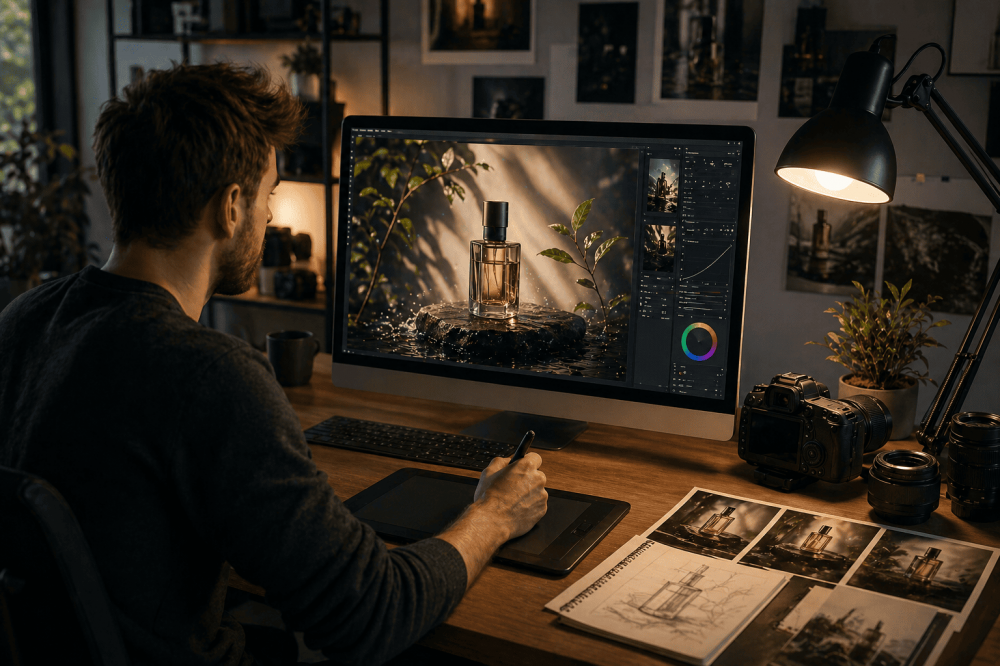
You are probably wondering why we use it and how it differs from AI in product photography — here, we will clear up your doubts. Let’s start with the first interesting point: why do we use it? First of all, it is about speed and savings. Instead of organizing very expensive photoshoots, AI can generate various realistic images in just a few minutes. This makes a huge difference for campaigns that require many variants. Creating the impossible. AI allows us to create scenes that are difficult to photograph, and sometimes even impossible, such as a photo in space. Retouching and corrections. AI removes imperfections and even makes it possible to change the background without the need for manual editing by a graphic designer.
Is AI necessary?
It is not always necessary or used. AI is meant to make our work easier in many cases, but for example, it is not needed for small projects or when authenticity is the key factor. Also, in campaigns featuring people and emotions, AI can sometimes look too artificial — and that is not the point of working with artificial intelligence. In many cases, people are happy to use the support of artificial intelligence, most often when a project has a limited budget or timeframe, as well as in large e-commerce campaigns. The most important thing: AI is a tool, not a replacement.
AI in advertising photography vs AI in product photography
The goal of advertising photography is to attract attention, build emotions and tell a story, for example by showing perfume in a luxurious setting. The risk and limitation in advertising photography is that the image may look too artificial or sometimes fail to reflect the real appearance of the product.
The goal of product photography is to show the product as it really is — with an emphasis on clarity and details that support the purchasing decision, such as a white background and a clear view of a sweatshirt. The risk and limitation in product photography is that the image must be accurate and realistic, and too much use of AI may mislead the customer.
How is AI changing advertising photography?
1) Creating images without a photography studio
The process looks like this:
• you send a product photo or description
• you choose the campaign style (e.g. premium, lifestyle, minimalist)
• AI generates a ready-to-use advertisement
2) Generating complete advertising campaigns
AI does not stop at a single image. It can create:
• advertising banners
• social media ads
• display graphics
• materials for A/B testing
3) Real-time ad personalization
AI makes it possible to tailor an ad to:
• the user’s location
• the season
• age and interests
• purchasing behavior
4) Automatic retouching and optimization
AI can automatically:
• improve lighting and colors
• remove imperfections
• increase resolution
• adapt the image to the platform (Instagram, Google Ads, Allegro)
5) Testing multiple ad versions (A/B testing)
Instead of one ad, you can have:
• 10 background versions
• 5 composition styles
• different colors and layouts
The most important AI tools in advertising photography
Ad and image generation
• Midjourney – high-quality advertising visuals
• DALL·E – fast campaign visualizations
• Stable Diffusion – full control over style
Advertising and marketing creation
• AdCreative.ai – generating ads focused on conversion
• Canva AI – fast marketing designs
• Creatopy – banner automation
Product photography + advertising
• Pebblely – lifestyle scenes for products
• Flair AI – creative product arrangements
• Photoroom – quick editing and advertising backgrounds
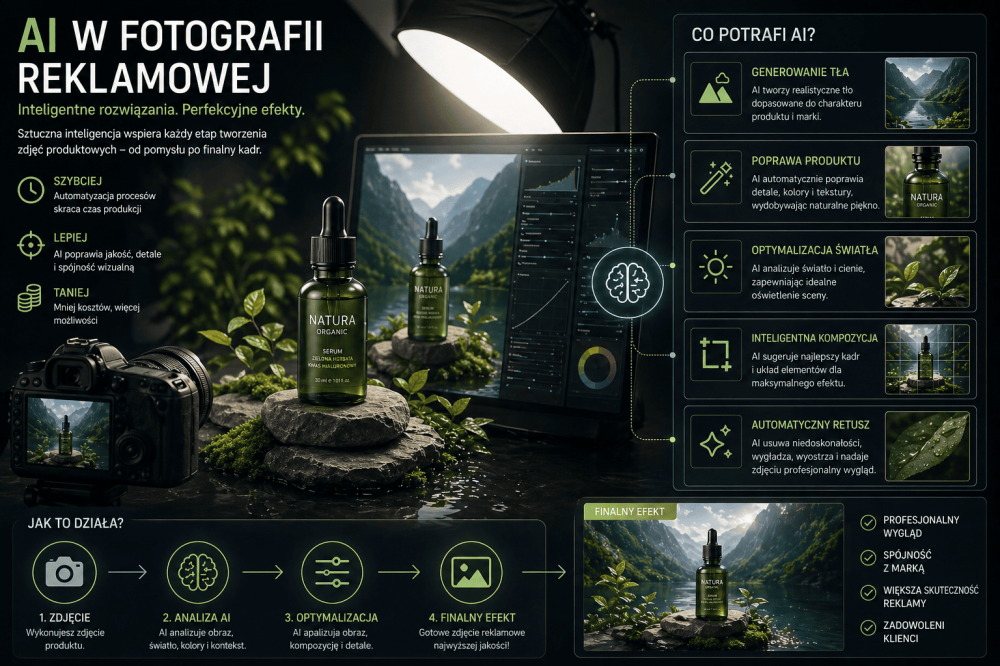
Key factors and aspects of AI in advertising photography
- Limitations and challenges — Many customers may notice that an image looks too perfect or artificial.
- Benefits for companies — One of the benefits is that there is no need to rent a studio, hire models or organize photoshoots. Another benefit may be faster advertising campaigns — something that used to take several weeks can now take just a few hours. Another advantage is the ability to run more advertising tests, making it possible to create hundreds of variants without additional costs.
- The future of advertising photography — In the coming years, we can expect more advanced advertisements generated “live” for each user, as well as the replacement of traditional photoshoots in many industries. Fully automated advertising campaigns may also become more common.
- Ad personalization — AI allows us to create advertisements tailored to the recipient’s age, gender, location, season and purchasing behavior.
- Virtual models and digital worlds — We are increasingly seeing advertisements featuring characters that do not actually exist. These include virtual models, generated faces and entire digital sets.
- Challenges and ethics — The development of AI in advertising photography brings many controversies. Questions arise about the authenticity of images, copyright, the impact on the job market for photographers and the promotion of unrealistic standards.
These are topics that the industry is only beginning to analyze seriously. AI in advertising photography is no longer just a passing trend, but a real working tool. It changes the way advertising campaigns are created and lowers their production costs. It does not completely replace human creativity, but it changes its role — from taking photos to designing visual brand experiences.
#AIwfotografiireklamowej#sztucznainteligencjawfotografii#fotografiaproduktowaAI#fotografiareklamowa#zdjęciaproduktowe#wizualizacjeproduktowe#marketingwizualny#contentdlae-commerce#zdjęciadoreklamy#nowoczesnafotografia#AIwmarketingu#kreatywnafoto

Rafał
Specjalista ds. marketingowo-handlowych